





Jigsaw puzzles have long been a beloved pastime for people of all ages. They offer a unique blend of relaxation, challenge, and satisfaction as the pieces come together to form a complete picture. However, not all jigsaw puzzles are created equal. Among the various types, ribbon cut and random cut jigsaw puzzles stand out as two distinct styles, each offering a different puzzling experience. In this blog post, we'll dive into the differences between ribbon cut and random cut jigsaw puzzles, exploring their characteristics, pros, and cons to help you decide which type might be the perfect fit for your next puzzle adventure.
What is a Random Cut Jigsaw Puzzle?

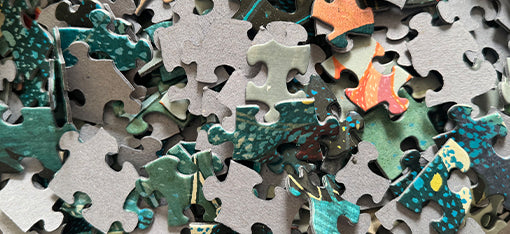
Random cut jigsaw puzzles break away from the traditional grid pattern, offering pieces of various shapes and sizes. This style often results in a more organic and less predictable assembly process. Key features include:
- Variety: Pieces come in a wide range of shapes and sizes, with unique and irregular interlocking patterns.
- Unpredictability: The randomness of the pieces adds an element of surprise and challenge, as it’s harder to predict how pieces will fit together.
- Organic Edges: Pieces often have curved or wavy edges, adding to the complexity of the puzzle.
Pros of Random Cut Puzzles
- Increased Challenge: The irregular shapes and unpredictable patterns provide a greater challenge, appealing to experienced puzzlers seeking a more engaging experience.
- Visual Interest: The variety in piece shapes can make the puzzle more visually interesting and satisfying to complete.
- Unique Fit: Each piece has a distinctive fit, reducing the likelihood of placing a piece incorrectly.
Cons of Random Cut Puzzles
- Higher Difficulty: The increased complexity can be daunting for beginners or those looking for a more straightforward puzzle experience.
- Sorting Complexity: Organizing pieces by shape, color, and pattern can be more challenging, potentially increasing the time and effort required to complete the puzzle.
- Less Predictable Fit: The lack of uniformity means that pieces may not fit together as smoothly, leading to potential frustration.
Shop New York Puzzle Company random cut jigsaw puzzles
What is a Ribbon Cut Jigsaw Puzzle?

Ribbon cut jigsaw puzzles, also known as traditional or grid cut puzzles, are characterized by their uniform, grid-like arrangement of pieces. In this type of puzzle, pieces are typically shaped with straight edges and predictable interlocking tabs and blanks. Here are some key features:
- Uniformity: Pieces in a ribbon cut puzzle tend to be similar in shape and size, often arranged in rows and columns.
- Predictability: The interlocking pattern is regular, making it easier to predict how pieces will fit together.
- Straight Edges: Many pieces have straight edges, especially those on the borders, which can simplify the initial sorting and assembly process.
Pros of Ribbon Cut Puzzles
- Ease of Assembly: The uniformity and predictability of ribbon cut puzzles make them generally easier and quicker to assemble, making them ideal for beginners or those looking for a more relaxed puzzling experience.
- Organizational Simplicity: Sorting pieces by shape, color, and pattern can be more straightforward, reducing the initial complexity.
- Satisfying Fit: The regular interlocking tabs and blanks provide a satisfying "click" when pieces fit together correctly.
Cons of Ribbon Cut Puzzles
- Lower Challenge: For experienced puzzlers, the predictability and uniformity may reduce the overall challenge and excitement.
- Limited Variety: The repetitive shapes and patterns can make the puzzle feel monotonous over time.
Shop New York Puzzle Company ribbon cut jigsaw puzzles
Which Type Should You Choose?

The choice between ribbon cut and random cut jigsaw puzzles ultimately depends on your personal preferences and puzzling goals. Here are a few considerations to help you decide:
- Skill Level: If you're new to puzzling or prefer a more relaxed experience, a ribbon cut puzzle might be the way to go. The uniformity and predictability can make the process more enjoyable and less frustrating.
- Challenge: If you’re an experienced puzzler or seeking a greater challenge, random cut puzzles offer a more complex and engaging experience. The unique piece shapes and irregular patterns can keep you on your toes and provide a greater sense of accomplishment.
- Time: Consider how much time you want to spend on the puzzle. Ribbon cut puzzles can typically be completed more quickly, while random cut puzzles may require more time and patience.